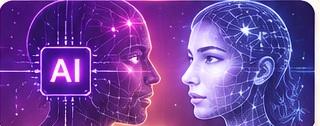
“Can AI predict your soulmate's face?” is a question that sounds futuristic but hides a category mistake. AI can generate a face. It can describe patterns in a birth chart. What it cannot do is retrieve the face of a person you have not met, because that person is not in any dataset and the future is not a lookup table. Once you separate generation from prediction, the technology becomes easier to understand and much harder to oversell.
This article explains what actually happens inside an AI-assisted soulmate sketch, where the astrology ends and the image model begins, and how to tell a transparent product from a misleading one.
Two different systems are working together
An AI soulmate sketch is usually a pipeline, not a single model. The first stage is a symbolic interpreter: a rules engine or language model reads your birth details and produces a structured description of partnership themes. The second stage is an image generator: a diffusion or similar model turns that description into a picture. Neither stage has access to your future. Both are producing plausible output from patterns.
This distinction matters because marketing often collapses the two stages into one claim. “AI analysed your kundli and drew your soulmate” sounds like one magical act. In reality it is a chain of translations, each of which loses precision: chart to interpretation, interpretation to prompt, prompt to image. The final drawing is several interpretive steps away from the original symbols.
What the astrology layer contributes
The astrology layer supplies structure. It might identify the seventh-house sign, the condition of its lord, the placement of Venus and Jupiter, and a timing period. It then maps those factors to adjectives: steady, communicative, ambitious, private, nurturing, independent. Those adjectives become the bridge to the image prompt.
Without this layer, an image model would produce a random face. With it, the face is at least thematically consistent with the report. That is a real difference in user experience, but it is not evidence of predictive accuracy. A horoscope-themed random generator with good art direction could produce an equally convincing image.
What the image layer actually does
Image models learn statistical relationships between text and pictures. When asked for “a calm, approachable South Asian woman in her late twenties, pencil sketch, modest clothing”, the model samples from those learned relationships. It does not search a photo library. It does not know your name, your address, or your ex-partner. It produces a new image that fits the prompt's statistical neighbourhood.
This is why the same prompt can produce different faces on different runs, and why small wording changes alter the result. It is also why the output can resemble someone you know: common feature combinations are, by definition, common. Resemblance is a property of statistics, not a sign of destiny.
Where bias enters
Every image model carries cultural and visual biases from its training data. Prompts about “traditional” or “modest” clothing can default to narrow regional aesthetics. Skin tone, hair texture and body type may cluster around whatever the training data over-represented. A responsible product should acknowledge this and let users describe their cultural context, rather than pretending the model is neutral.
Astrology itself carries cultural assumptions too. Classical texts were written in specific societies with specific ideas about gender and marriage. Modern readings should be explicit about which conventions they are using and should not present them as universal facts. A sketch that quietly encodes one narrow idea of an ideal partner is doing more than drawing a face; it is reinforcing a norm.
What “prediction” can legitimately mean
In product language, “prediction” often means “generated interpretation”, not “forecast of a verifiable event”. That is acceptable if the label is clear. It becomes deceptive when the same word is used to imply that a real person has been identified. A transparent product will say: this is an AI-generated artistic impression based on traditional symbolism. It will show the demo label on the image. It will avoid phrases like “your actual soulmate” or “guaranteed match”.
RewaAI takes that position deliberately. When no image service is configured, the platform displays a labelled placeholder rather than pretending a live generation happened. When a report is produced without a configured language model, it is marked as demo mode. The goal is to make the method inspectable rather than magical.
How to evaluate an AI soulmate sketch product
- Does it label generated images? Look for a visible “AI-generated” or “demo” marker, not a footnote buried in the terms.
- Does it explain the method? A credible product describes the chart factors and the image pipeline in plain language.
- Does it promise a real person? If it does, treat that as a red flag. No service can deliver that.
- Does it handle privacy seriously? Birth details are sensitive. Check what is stored, who can see reports, and whether guest links are unguessable.
- Does it avoid fake testimonials? Sample reviews should be labelled as samples. Invented aggregate ratings are a sign of a product that prioritises conversion over honesty.
- Does it let you see a sample first? A sample report should show the real structure, including disclaimers and demo labels.
The honest version of the claim
The most accurate sentence an AI astrology product can say is: “We use traditional Vedic symbolism to generate a reflective report and an artistic portrait. The portrait is not a real person and the report is not a guarantee.” That sentence is less exciting than “meet your soulmate's face tonight”, but it is true, and it leaves room for the product to be genuinely enjoyable.
AI is good at making symbolic systems feel personal and immediate. That is a real contribution. It is not the same as prediction, and the difference is worth protecting. If you understand the pipeline, you can enjoy the output without handing it authority over your life.
The prompt is the product
In an AI soulmate sketch, the image prompt is where most of the product decisions live. The prompt decides the style, the age range, the clothing, the expression and the cultural context. Two companies with the same chart data can produce very different sketches simply by writing different prompts.
A responsible prompt includes constraints: adult subject, modest clothing, no resemblance to a known person, pencil or watercolour style rather than photorealism, neutral background, and a clear artistic label. These constraints reduce harm. They also make the image less likely to be mistaken for a photograph of a real individual.
A careless prompt does the opposite. It asks for a photorealistic portrait, uses words like “your actual soulmate”, and omits any label. That combination is designed to produce an emotional response that the method cannot justify. The technology is not lying; the framing is.
This is why you should judge an AI astrology product by its constraints as much as its outputs. A beautiful image with clear labelling is more honest than a stunning image presented as evidence.
What would change our mind
If a company claimed genuine predictive accuracy, what evidence would be convincing? A pre-registered study, a clear outcome definition, a blinded scoring process and a large sample followed over time. Ideally, sketches would be generated before any meeting and compared with the eventual partner by independent judges who do not know which sketch belongs to whom.
No such study exists in the public record. Until one does, the honest position is that AI can generate a face, and astrology can generate an interpretation, but neither can identify a future person. That position is not anti-technology. It is simply a description of what the technology does.
The good news is that you do not need predictive accuracy to enjoy the product. A well-made report can be a beautiful ritual, a prompt for reflection, and a way to start conversations about what you want. Those benefits are real even if the prophecy is not.
To see the structure for yourself, open the sample report. For a deeper look at the astrology side, read understanding the seventh house, and for a candid accuracy discussion, see how accurate soulmate sketches are.