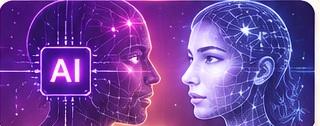
Astrology has always adapted to technology. Printed ephemerides replaced hand calculations; software replaced tables; websites replaced newspaper columns. AI is the latest shift, and it changes something more fundamental than speed: it changes how interpretations are generated and how personal they feel. That is both an opportunity and a risk.
This article examines what AI actually changes in astrology, where it adds value, where it misleads, and what a responsible AI astrology product should look like.
From calculation to interpretation
Early astrology software automated arithmetic: planetary positions, house cusps, dashas. The interpretation remained human. AI changes that by generating language, images and structured reports at scale. A language model can produce a coherent reading in seconds, tailored to the user's chart and question.
This is genuinely useful for access. Someone who cannot afford a personal astrologer can receive a detailed report for a modest price. Someone who is curious at midnight can get an answer immediately. The trade-off is that the interpretation may be generic, inconsistent or confidently wrong.
Personalisation at scale
AI can combine chart factors with user context — relationship status, goals, past reports — to produce a more relevant reading. It can also adapt tone: gentler for someone who is anxious, more direct for someone who wants brevity. That flexibility is hard to achieve with static content.
But personalisation can slide into flattery. A model trained to maximise engagement may tell people what they want to hear. It may avoid difficult interpretations or overstate certainty. A responsible product needs guardrails that prioritise honesty over satisfaction.
The hallucination problem
Language models can invent astrological rules, misattribute classical texts, or produce confident claims with no basis. This is especially risky in astrology, where the line between tradition and invention is already blurry. A model might say “your seventh lord in the tenth house means you will marry an engineer” when no classical source supports that specificity.
Guardrails help: structured chart data, a curated rule library, retrieval from verified sources and explicit uncertainty. But no system is perfect. Users should be told when a claim is traditional, when it is interpretive, and when it is generated filler.
Images and the illusion of evidence
AI image generation makes soulmate sketches visually compelling. A realistic face feels like evidence, even when we know it was generated. This is a known cognitive effect: realism increases perceived credibility. Products that display such images without a clear label are exploiting that effect.
A responsible platform labels generated images, avoids photorealism that implies a real person, and explains the pipeline from chart to prompt to image. RewaAI uses pencil-style demo sketches and labels them as artistic impressions for this reason.
Bias and representation
AI models inherit biases from training data. Astrology adds its own cultural biases. Together, they can produce readings and images that assume a narrow idea of gender, beauty, family or marriage. A responsible product should acknowledge this, allow users to specify context, and avoid presenting one cultural script as universal.
Privacy and data
Birth details, relationship questions and payment information are sensitive. AI services often process data through third-party APIs, which raises questions about retention and sharing. Users should be able to see what is stored, delete their account, and understand whether their data is used for training.
RewaAI keeps reports private by default and stores only what is needed to generate and display a reading. Secrets stay server-side, and payment credentials are handled by the gateway, not the app. These are baseline expectations, not premium features.
What AI does not change
AI does not make astrology scientifically validated. It does not give the model access to the future. It does not resolve the fundamental ambiguity of symbolic interpretation. It makes the output faster, cheaper and more personalised, but it does not change the epistemic status of the claim.
That is why the honest framing remains the same: astrology is a traditional interpretive system, useful for reflection and entertainment, not a guarantee of events. AI can make that system more accessible, but it cannot make it more certain.
What a good AI astrology product looks like
- Explains its method in plain language.
- Labels AI-generated text and images.
- States uncertainty and avoids fake precision.
- Protects user data and minimises collection.
- Avoids fear-based upsells and guaranteed outcomes.
- Uses real reviews or clearly labelled samples.
- Lets users see a sample before paying.
The bottom line
AI is changing astrology by making personalised interpretation and imagery accessible at scale. That is a real shift, with real benefits and real risks. The technology does not settle the question of whether astrology works; it only changes how the conversation is delivered. Choose products that are transparent about both.
A short history of astrology technology
Astrology has always been an information technology. Clay tablets, paper ephemerides, mechanical calculators and mainframe software each changed who could produce a chart and how quickly. The underlying symbolic system stayed relatively stable; the production layer changed.
Early computer astrology generated chart wheels and basic planet lists. Later software added interpretations, compatibility scores and report templates. The internet made those reports cheap and global. AI adds natural-language fluency and image generation, which makes the output feel more personal and more authoritative.
Each shift produced the same debate: does automation dilute the craft? The answer depends on how the tool is used. A calculator does not make an astrologer wise, and a language model does not make an interpretation true. The tool changes access, not epistemology.
What to ask before using an AI astrologer
- What data will you store, and can I delete it?
- Is the interpretation generated by a model, a rule library, or a human?
- Will you label AI-generated images and text?
- How do you handle uncertainty and birth-time errors?
- Do you use fear or urgency to sell upgrades?
- Can I see a sample before paying?
- Are your reviews real, or clearly labelled samples?
These questions are not technophobic. They are the same questions you would ask of any service that handles personal data and makes claims about your life.
Human in the loop
The most promising model is not AI replacing astrologers but AI handling the repetitive layer while a human handles judgement. Chart calculation, formatting, first-draft interpretation and image prompting can be automated. The human reviews for tone, flags overreach, adds context and answers questions the model cannot.
This division of labour is common in other fields. A calculator does the arithmetic; the engineer checks the assumptions. A drafting tool proposes language; the editor decides what is true. Astrology can adopt the same pattern instead of pretending that automation is authorship.
For users, the practical question is: who is accountable for this reading? If the answer is “the model”, there is no one to ask for clarification or correction. If the answer is a named team, you have recourse. Accountability is a feature, not a legal formality.
The economics of personalised astrology
Personal readings used to be expensive because they took time. AI lowers the marginal cost of a report dramatically, which makes personalised astrology available to people who could never afford a consultation. That is a genuine democratising effect.
It also creates pressure to sell volume. If reports are cheap to produce, the business model shifts toward subscriptions, upsells and engagement loops. That is where honest labelling becomes commercially inconvenient. A product that tells you the output is a demo may convert less well than one that promises certainty.
The companies that resist that pressure will need another source of trust: clear pricing, real reviews, visible disclaimers and a willingness to say “this is entertainment”. Those signals are slower to build than a bold claim, but they last longer.
For more, read can AI predict a soulmate's face and how accurate soulmate sketches are.